EXPERT ARTICLE
The leads are there,
why aren’t they converting?

Consider a common scenario.
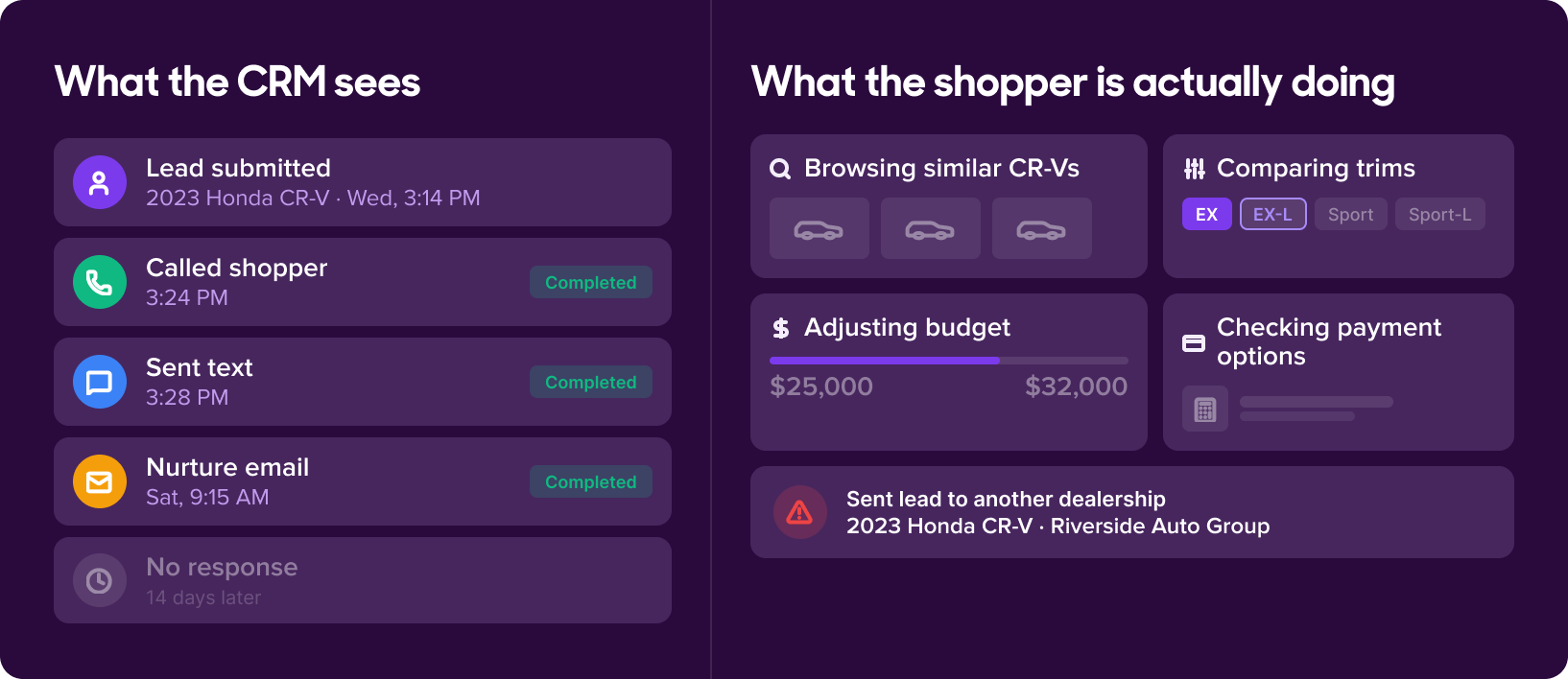
A shopper submits a lead on a used 2023 Honda CR-V at Neighborhood Motors on a Wednesday afternoon. The BDC does everything right: a call and text within ten minutes, a follow-up the next morning, another on Saturday, then automated nurture emails as the CRM takes over.
14 days later, the lead looks cold. But what if the shopper isn’t?
They may still be researching similar CR-Vs, reconsidering their budget, comparing another trim or talking to another dealership. The problem is that most of that activity happens outside the original lead record.
From the CRM’s point of view, the shopper went quiet. From the shopper’s point of view, the decision kept moving.
Dealers can spend a lot of time diagnosing lead quality when the bigger opportunity may be improving what their team can see and how quickly they respond when a shopper shows fresh intent.

Why does “lead quality” take the blame?
Lead quality is an easy explanation because it’s visible.
A lead comes in and a rep works the process. Calls, texts and emails are logged, but nothing closes. Eventually, the rep, or a manager reviewing the pipeline, marks it closed-lost.
Sometimes that’s true. Some leads are stronger than others, and follow-up execution matters. But a CRM usually tells you much more about what your dealership did than what the shopper did next.
That’s the blind spot.
A more useful question than “Was this a good lead?” is: “What has this shopper done since the lead arrived, and would we know if their intent changed?”
A lead isn’t a static event
Most dealership processes treat a lead as a moment in time. A shopper raises their hand at 2:14 p.m. on Wednesday, and the CRM captures what was known at that moment: contact information, vehicle of interest, source, and timestamp.
From there, the dealership adds its own activity:
- Calls
- Texts
- Emails
- Notes
- Appointment attempts
But shoppers don’t stop shopping once they submit a lead. They revisit vehicles, change price ranges, compare trims across competing inventory, or leave the market temporarily and come back days or weeks later.
That means two leads that look identical in a CRM can represent very different opportunities. One shopper may have stopped shopping altogether, while the other may have spent last night comparing three vehicles and contacting another dealership.
If both records simply say “Day 12: no response,” the team has no reason to treat them differently.


The real problem with time-based follow-up
Dealerships need follow-up cadences because without them, leads fall through the cracks. The problem comes when time becomes the only signal determining what happens next.
Day 1 gets one touchpoint. Day 3 gets another. Day 7 gets another. Eventually, the lead moves into long-term nurture or closed-lost.
That’s operationally efficient, but shopper intent isn’t simple. A shopper on day 14 who became active again last night may deserve more attention than a brand-new lead who hasn’t shown another signal of interest.
Most “hot,” “warm” and “cold” labels reflect how a lead looked the day it arrived. However, what’s happening with that shopper right now is most likely different. You have to address your current process if you can’t tell the difference — more lead volume won’t fix it.
Start measuring recency of intent
A better prioritization system combines lead age with behavioral recency.
The exact signals available to your dealership will depend on your CRM, website, lead source partners and other technology. But the principle is universal: when a shopper gives you new evidence that they’re moving toward a decision, your process should notice and evolve.
That evidence could include a new call or text, a return website visit, renewed engagement with a vehicle, a new trade or financing action, another marketplace interaction or a competitive-shopping signal provided by one of your partners.
No single signal guarantees a sale. What matters is whether the new behavior gives your team a better reason to act now, and more information to work with when they do.
A simple framework for prioritizing follow-up
You don’t need to rebuild your entire BDC process to put this idea to work. Start with three tiers.
| Tier | Signal | What to do |
|---|---|---|
| Tier 1: Fresh activity | An existing lead shows a new, meaningful sign of intent, whether the original lead arrived yesterday or three weeks ago. | Move it to the top of the queue now. Respond to what changed, not what was there before. |
| Tier 2: Strong new leads | A recent inquiry comes in with enough context to make the first conversation relevant: clear vehicle interest, an identifiable price range, or repeated engagement. | Respond fast, and make it personal. A quick, generic reply is still generic; reference what you actually know about this shopper. |
| Tier 3: Standard nurture | No meaningful new activity on the lead. | Keep it in your normal cadence. Just don’t let it outrank a shopper who became active again this morning. |
Then change the conversation, not just the priority
Better visibility only helps if the outreach changes with it. If a shopper resurfaces, the wrong response is simply another version of: “Just checking in to see if you’re still interested.”
Use whatever new context you legitimately have to make the conversation more useful.
| If the shopper… | Then… |
|---|---|
| Is looking at a different trim | Talk about the difference, not just the original vehicle |
| Has an apparent price range that’s changed | Help them compare relevant choices in that new range |
| Re-entered the market after two weeks of silence | Treat it as new information and start the conversation fresh |
The goal is to use what you know to eliminate unnecessary questions and help them make a decision.
Build this into the daily process
Two habits can make behavioral prioritization much more practical.
First, give fresh activity a defined place in the team’s workflow. Whether that’s a CRM task, a tag, a filtered queue or a daily report, don’t depend on someone remembering to look for it.
Second, define what happens when that signal appears.
- Who owns the follow-up?
- How quickly should they respond?
- What context should they review first?
- When does a previously closed or inactive lead reopen?
A signal that nobody owns is just another notification.


Audit your technology for visibility, not just lead delivery
This is also a useful way to evaluate lead partners and sales technology. Dealers naturally ask how many leads a source generates and how much each lead costs.
Add another set of questions you need the answers for:
- What do I know about the shopper besides their contact information?
- Can I see how their interests are changing?
- Does the information update after the initial lead?
- Can my team see renewed intent without logging into another system?
- Does that information arrive somewhere my team already works?
- Can I use those signals to prioritize follow-up?
Those questions shift the conversation from lead delivery to lead context.
And that matters because generating an opportunity and helping a dealership recognize when that opportunity is becoming active again are two different jobs.
Find out which lead sources are making you money
This free AI prompt turns your own lead source numbers into a ranked profitability breakdown: cost per lead, cost per sale, marketing ROI, and return multiple. Copy it into ChatGPT, Gemini, Claude, or any AI assistant you already use. No login, no new tool to learn, just your numbers and about 10-15 minutes.
Get the free AI PromptHow Cars.com applies this model
Cars.com is one example of putting that additional context into the existing dealership workflow.
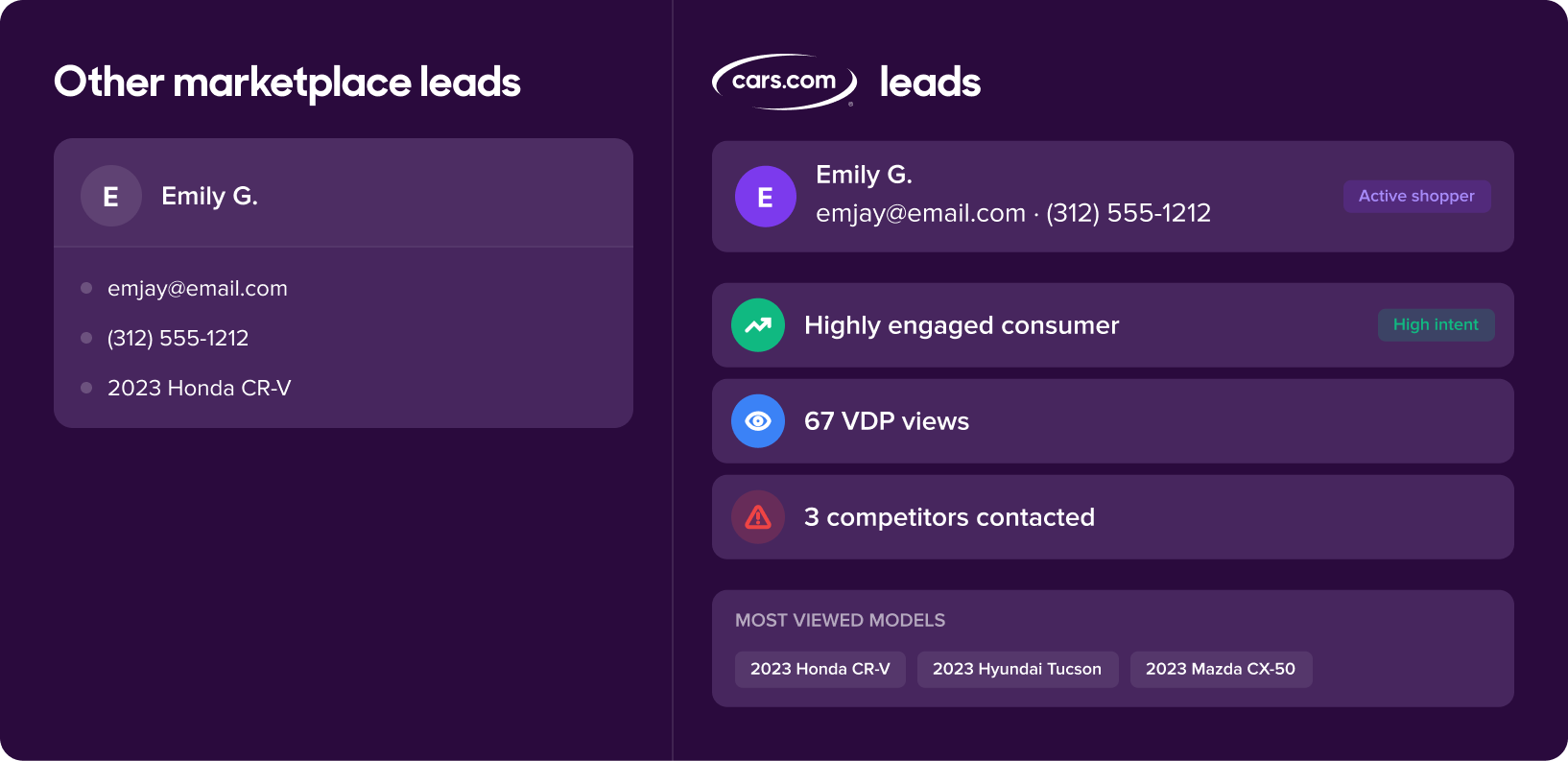
This is where Cars.com leads work differently. Shopper Details and Shopper Alerts close the visibility gap in two ways.
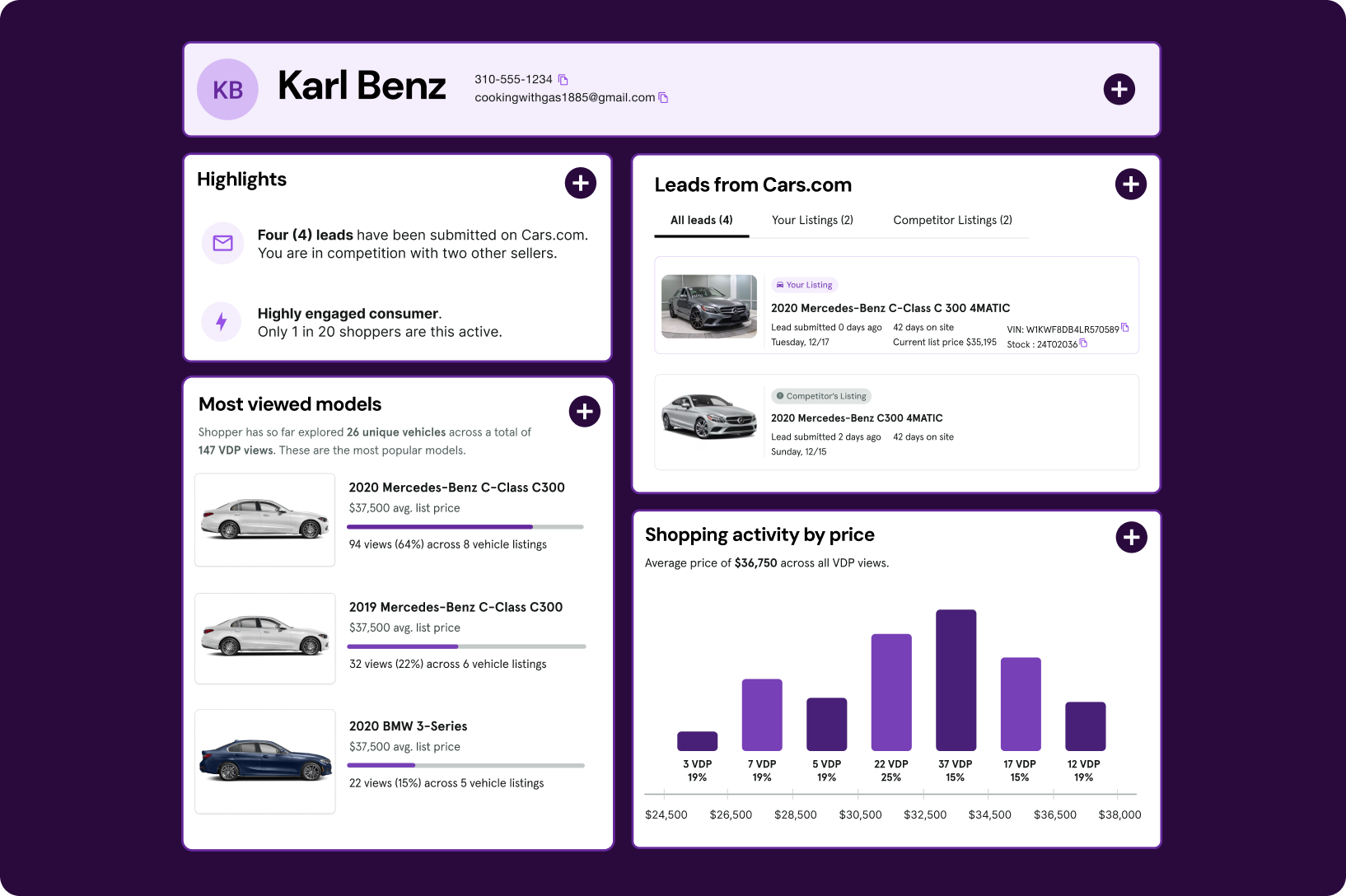
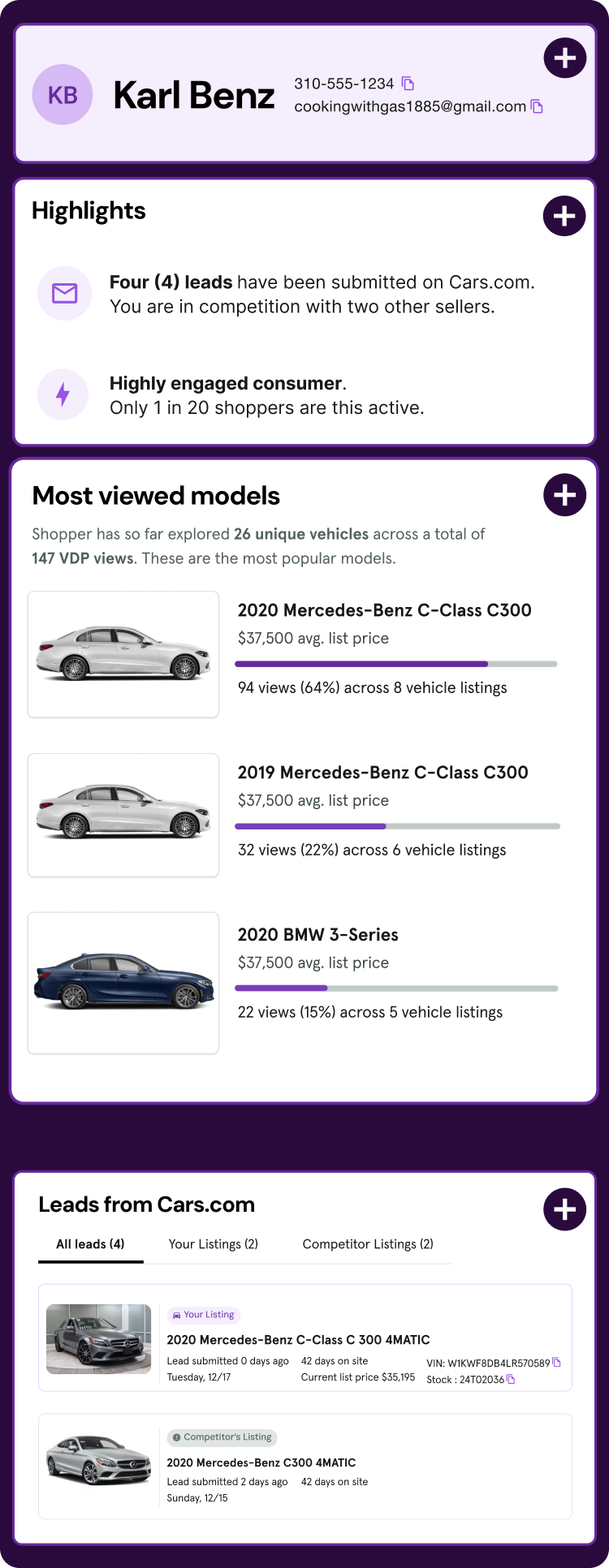
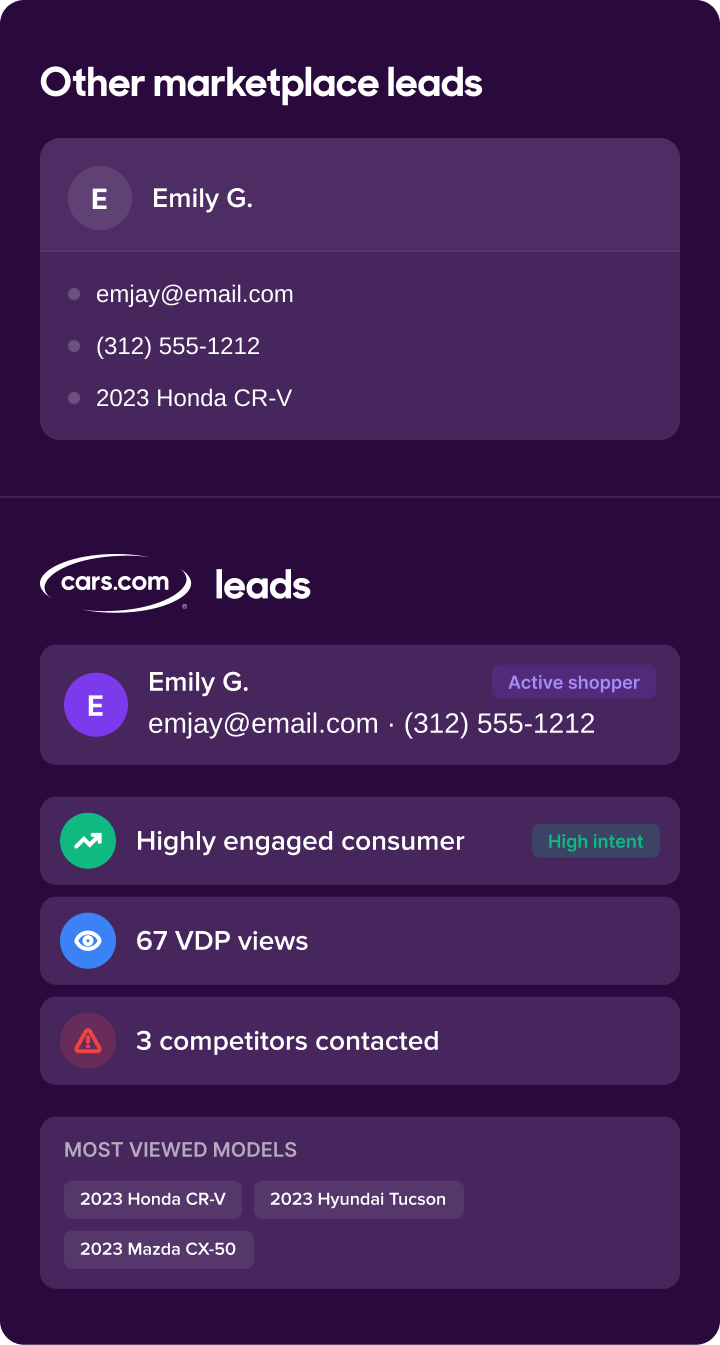
Shopper Details adds context to Cars.com leads, including the shopper’s vehicle interests, consideration set, price range and engagement with other dealers’ inventory. Instead of beginning every conversation with only a name and vehicle, the salesperson can start with a better picture of what the shopper is considering.
Shopper Alerts extends that visibility after the original inquiry. When a shopper a dealership has already connected with submits another lead to a competing dealership on Cars.com, the dealer receives an alert in its CRM shortly thereafter.
The underlying principle is a lead shouldn’t become invisible simply because the original conversation went quiet. The more clearly a dealership can identify fresh intent, the more intelligently it can decide who deserves attention next.
Together, these tools tell a team who came back into the market and what’s already known about them before anyone picks up the phone.
A gut-check before your next pipeline review
Pull up a sample of leads your team currently considers cold or closed-lost and ask:
- Do we know whether any became active again this week?
- What evidence would cause us to reprioritize one?
- Is our CRM showing shopper behavior or primarily our own follow-up activity?
- Are our salespeople getting enough context to make their next conversation different from the last one?
- Which signals do our current vendors provide after the initial lead?
- Who on the team is responsible for acting on them?
If those questions are hard to answer, start there.
You may not need another source of leads. You may need a better way to recognize movement inside the opportunities you already have.
The smartest path starts with visibility
Before you finalize your lead providers and third-party partners for next quarter, take another look at what’s already sitting in your pipeline. Some of the shoppers worth prioritizing may already be there — and showing new signs of intent your team can’t currently see.
Shopper Details and Shopper Alerts give your team more visibility into Cars.com leads, so they can see more shopper context and know when previously engaged shoppers become active with another dealer.
Common lead quality questions
Why aren’t my dealership’s leads converting even though volume is up?
There isn’t one universal cause. Review response time, contact strategy, lead source, merchandising, pricing and appointment process — but also check whether your team can identify shoppers who re-engage after the original lead. More volume won’t correct a visibility problem.
Is lead quality or lead quantity the bigger problem?
Both matter, but neither should be evaluated in isolation. Look at the signals behind the lead: specificity, engagement, recency and how shopper behavior changes after the inquiry.
What is Shopper Details on Cars.com?
First-party shopper intent data attached to Cars.com leads, including vehicle interest, price range, and engagement with other dealers, delivered directly into a dealer’s CRM.
What is Shopper Alerts on Cars.com?
A real-time notification, delivered to a dealer’s CRM, when a shopper they’ve previously connected with submits a lead to a competing dealer — so the dealer knows the moment a “cold” lead is back in-market.
What’s a good approach to automotive lead prioritization?
Combine lead age with recent shopper activity. Give fresh signals of intent priority, respond quickly to strong new leads with useful context, and keep lower-activity opportunities in an appropriate nurture cadence.
What should I ask a lead provider about shopper data?
Ask what context comes with the original lead, whether the data updates after submission, which behaviors can trigger re-engagement, and whether those insights appear directly inside your dealership’s CRM.

)